
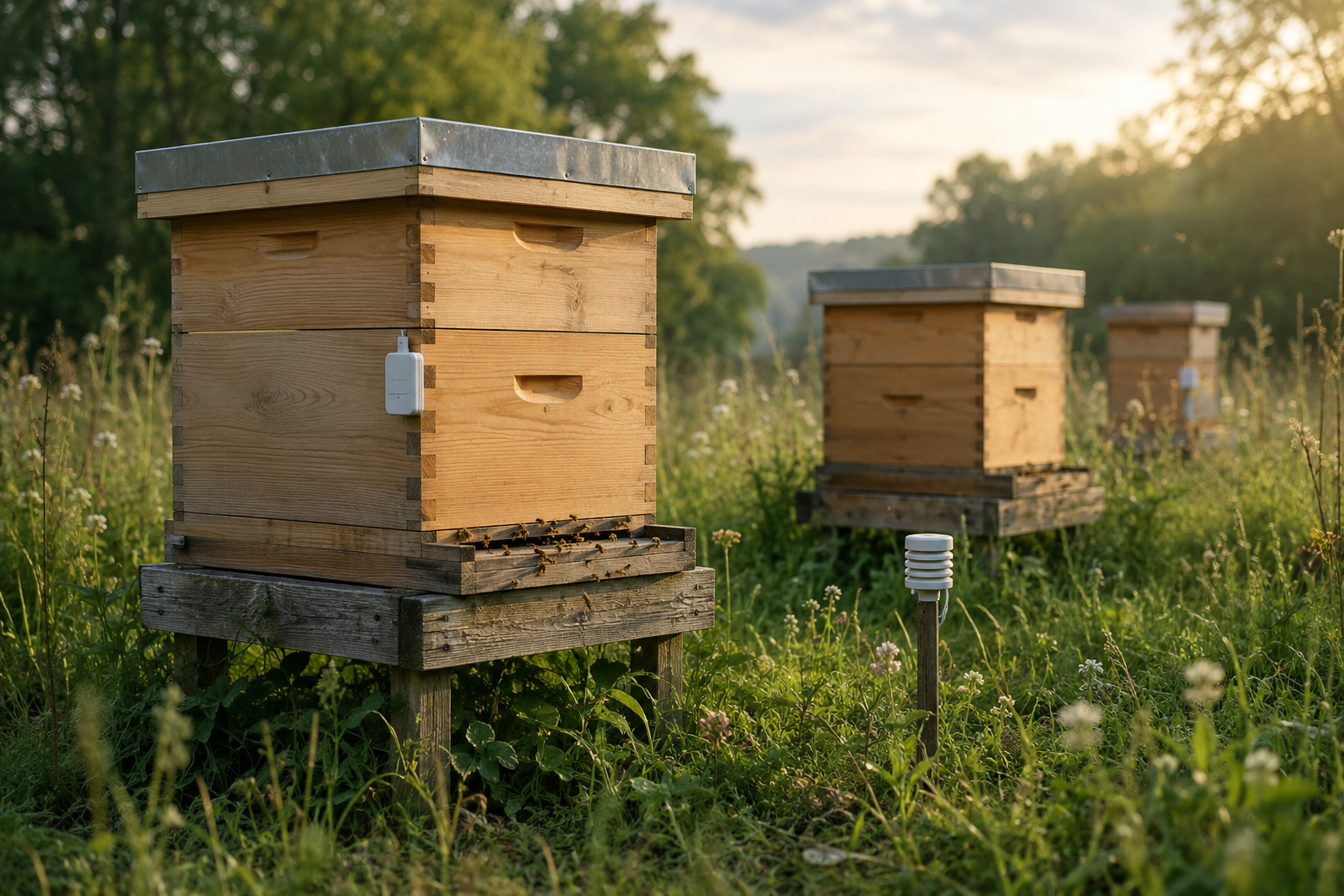
Most hive monitoring systems concentrate on what is happening inside the box. They measure brood temperature, humidity, hive weight or sound and then ask the beekeeper to interpret the resulting graphs.
WaggleNet takes a slightly different approach. The experimental monitoring system combines sensors inside the hive with sensors placed in the surrounding environment. Its aim is to help beekeepers understand not only what is changing inside a colony, but also what may be causing that change.
Developed by researchers Minju Jeon, Jiyun Kim, Sewon Kim, Seongmin Park, Bo Zhang and Anthony H. Smith, WaggleNet was presented in a research paper published in December 2025.
It is not currently a polished commercial product. It is a prototype and research platform. Nevertheless, its low-cost architecture and emphasis on environmental context make it one of the more interesting recent developments in precision beekeeping.
Why monitor outside the hive?
A temperature reading from inside a hive rarely tells the whole story.
If the internal temperature rises, the colony could be actively regulating the brood nest. Alternatively, the hive may simply be responding to unusually warm weather or direct sunlight. A change in humidity could indicate a ventilation issue, but it could also reflect changing conditions outside.
External temperature, humidity, light and weather influence:
- Foraging activity
- Colony thermoregulation
- Nectar availability
- Water demand
- Honey production
- The interpretation of internal hive readings
Monitoring both environments allows the beekeeper to compare conditions rather than viewing each internal measurement in isolation.
If two hives experience the same outdoor conditions but respond differently internally, that difference may warrant attention. Conversely, when several colonies change in a similar way at the same time, the cause may be environmental rather than colony-specific.
This contextual approach is WaggleNet’s most important idea.
How WaggleNet works
WaggleNet uses multiple small worker nodes placed inside hives and at positions around the apiary. Each node can record:
- Temperature
- Relative humidity
- Light intensity
- Location data
- Time of measurement
The worker nodes transmit their readings over LoRa to a master node. LoRa is a low-power radio technology designed to carry small amounts of sensor data over relatively long distances.
The master node acts as a bridge between the local sensor network and the internet. It receives the LoRa messages and forwards the data using MQTT, a lightweight messaging protocol widely used in Internet of Things systems.
The information is then made available through a cloud service and mobile application.
In simple terms, the architecture has three stages:
- Sensors collect measurements in and around the apiary.
- LoRa carries the readings to a nearby master node.
- The master node sends the information to an online platform.
This arrangement means every sensor does not need its own cellular or Wi-Fi connection. One gateway can support a group of monitoring nodes distributed across an apiary.
Low-cost monitoring
The researchers estimate the cost of an individual worker node at approximately $15, using readily available electronic components.
Low hardware cost matters because useful apiary monitoring often requires more than one sensor. A single instrumented hive may provide interesting information, but it cannot show whether a change is unique to that colony or shared across the apiary.
Affordable nodes make it more practical to monitor:
- Several colonies at once
- Different positions within an apiary
- Shaded and sun-exposed locations
- Internal and external conditions
- Control hives for comparison
This distributed model could be particularly valuable for research projects, teaching apiaries and beekeeping operations in regions where conventional commercial monitoring systems remain too expensive.
The quoted $15 figure should, however, be treated carefully. It relates to the component cost of a prototype worker node. It does not necessarily include weatherproof enclosures, assembly, installation, the gateway, cloud hosting, maintenance or commercial support.
What did the tests find?
During field testing, WaggleNet achieved 100 percent packet delivery over 110 metres with a clear line of sight.
In obstructed conditions, the system maintained communication over 95 metres. The researchers also tested nodes operating inside wooden hive structures.
Data reportedly travelled from the sensor to the application in under five seconds, and the prototype operated continuously during a two-month deployment.
These are promising results for a research system. They suggest that a single gateway could cover a compact apiary without requiring cables or individual internet connections for every hive.
They do not yet demonstrate how the system would perform across multiple seasons, in large commercial apiaries or under the wet, cold and frequently muddy conditions familiar to many beekeepers.
What WaggleNet does not measure
The present sensor package is relatively simple. It does not appear to include hive scales, microphones, carbon dioxide sensors, cameras or automated Varroa detection.
That limits some of the direct management conclusions that can be drawn from the data. Temperature, humidity and light can reveal meaningful changes, but they cannot independently diagnose queenlessness, disease, mite levels or imminent starvation.
The absence of weight monitoring is particularly noticeable. Hive weight remains one of the most practically useful remote measurements for identifying nectar flow, food consumption and possible swarming events.
WaggleNet should therefore be viewed as an environmental monitoring architecture rather than a complete electronic substitute for hive inspection.
Its value lies in showing how low-cost sensors can be distributed across an apiary and how external measurements can improve the interpretation of conditions inside each hive.
Could this approach improve smart beekeeping?
Many smart hive systems are good at collecting data. The harder problem is deciding what that data means.
WaggleNet points towards a more useful model in which the hive is not treated as an isolated box. Colonies exist within a wider physical environment. Temperature, sunlight, rainfall, surrounding vegetation and local microclimate all influence their behaviour.
A future version of the system could potentially combine its existing measurements with:
- Hive weight
- Acoustic monitoring
- Local rainfall and wind data
- Entrance activity
- Nectar flow records
- Inspection notes
- Disease and treatment records
With enough colonies and enough historical data, this could support more reliable anomaly detection. Instead of merely warning that a hive is hot, the system might recognise that one colony is responding differently from every other colony exposed to the same conditions.
That would be a much more useful alert.
The ApiTech World verdict
WaggleNet is not yet a finished hive-monitoring product and should not be judged as one. The published work describes an experimental system whose long-term durability, power consumption and practical value still need to be demonstrated at a larger scale.
Its significance lies in two ideas.
First, hive data becomes more meaningful when it is compared with conditions outside the hive. Second, a distributed monitoring network does not necessarily require expensive hardware at every colony.
At approximately $15 per worker node, WaggleNet presents an intriguing model for affordable, multi-hive environmental monitoring. Its sensors are simple, but the architecture is thoughtful.
Smart beekeeping will not advance simply by placing more sensors inside a hive. It will advance when those measurements are given enough context to help a beekeeper make a better decision.
WaggleNet may be an early step in that direction.
About the research
WaggleNet is described in the paper WaggleNet: A LoRa and MQTT-Based Monitoring System for Internal and External Beehive Conditions, published as a preprint in December 2025.
Read the WaggleNet research paper.
Suggested meta description: WaggleNet is an experimental $15 LoRa hive-monitoring node that compares internal beehive conditions with the surrounding environment.
Suggested excerpt: WaggleNet uses low-cost LoRa sensors inside and around beehives, giving beekeepers environmental context that conventional hive monitors often miss.
Suggested categories: Hive monitoring, Beekeeping technology, Product review
Suggested tags: WaggleNet, smart hive, LoRa, hive sensors, precision beekeeping, beehive monitoring