
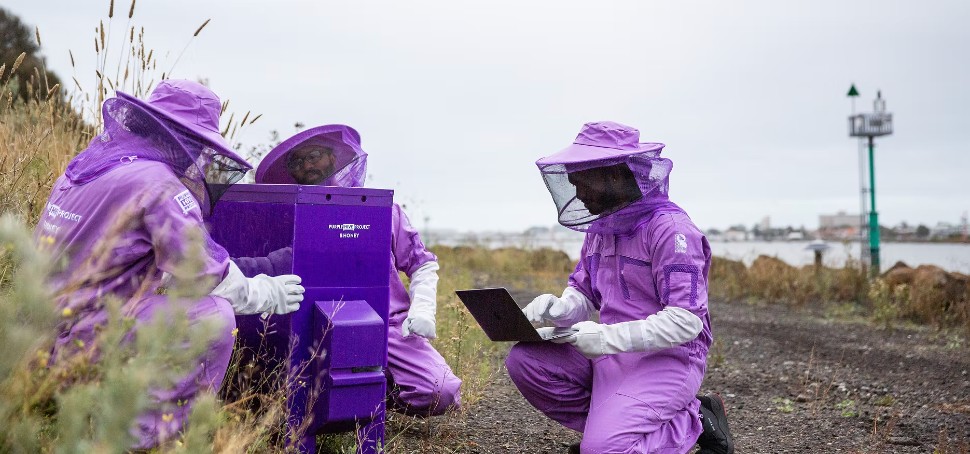
The Varroa destructor mite is one of the most destructive threats to honeybee colonies globally. These tiny parasites feed on bees and transmit deadly viruses, weakening hives and accelerating colony collapse. Tackling the Varroa problem requires smart integration of detection and treatment systems. In this post, we explore cutting-edge technologies and techniques—from AI-driven detection platforms to emerging RNA-based treatments—that are reshaping how beekeepers respond to this ongoing threat.

Detection Technologies: From Manual to Machine Learning
Manual Monitoring Methods
- Alcohol Wash: Highly effective but kills sampled bees; used to estimate infestation levels.
- Powdered Sugar Roll: Non-lethal method; results vary with environmental conditions and operator skill.
AI & Camera-Based Detection Systems
- BeeVS Portable Scanner: Uses AI image analysis on sticky boards to identify mite levels with less than 1% error when mites are present in sufficient numbers. More accurate than human assessments and useful for large apiaries.
- IntelliBeeHive Vision Platform: Employs YOLOv7-tiny neural networks to detect mites via entrance camera feeds with 99.6% precision. Can be integrated into smart hive setups.
- Vimana Tech Smart Hives (Australia): Fixed hive-mounted AI cameras that monitor bee activity and flag Varroa presence via SMS alerts. Deployed in field trials to assist in early containment.

Hyperspectral Imaging Experiments
- Academic trials have demonstrated success using U-Net algorithms and narrow-band spectral analysis to identify mite presence at a distance, opening future possibilities for drone or satellite-based hive surveillance.
Treatment Systems: An Integrated Pest Management (IPM) Approach
Soft Organic Treatments
- Oxalic Acid: Applied via vapor or dribble. Effective in broodless periods. No known resistance.
- Formic Acid (Mite-Away Quick Strips): Penetrates brood cells; can kill mites under caps. Efficacy >95% under ideal conditions.
- Thymol (Apiguard, Thymovar): Works in warmer temps (20–25°C). Temperature-sensitive and can affect brood.
- Hop Beta Acids: Low toxicity to bees and honey; variable mite control.
Synthetic Treatments
- Amitraz (Apivar): Highly effective but resistance has been observed in regions with repeated use.
- Pyrethroids (Fluvalinate, Coumaphos): Formerly common; resistance and contamination now limit effectiveness.
Alternative Approaches
- Thermal Treatments: Controlled hive heating to 41–42°C. Kills mites but narrow margin for bee safety.
- Botanicals and Powders: Wintergreen oil, neem, icing sugar. Inconsistent results and often stressful for colonies.
Emerging Solutions: Biotech and Gene-Driven Strategies
RNA Interference (RNAi) Inspired by mRNA vaccine technologies, new syrup-based treatments introduce RNA strands that silence vital mite genes. These show promising results in lab settings without harming bees or brood. Commercial deployment is expected within the decade.
Selective Breeding and Hygienic Behavior Programs in the U.S., Europe, and Brazil are breeding bees with increased grooming and mite-sensitive hygienic (MSH) traits. These bees can uncap and remove infected brood, slowing mite reproduction naturally.
Product Comparison Table
| Product/System | Type | Detection Accuracy | Treatment Efficacy | Notes |
|---|---|---|---|---|
| BeeVS Scanner | Portable AI Imaging | ~99% (with >10 mites) | N/A | Easy to deploy across yards |
| IntelliBeeHive | Smart Hive w/ AI Vision | ~99.6% | N/A | Integrates with full hive management system |
| Vimana Tech | Hive-Mounted AI Camera | Moderate-High | N/A | SMS alerts; used in Australia’s Varroa response |
| Mite-Away Quick Strips | Formic Acid | N/A | ~95% | Penetrates cappings; temperature-dependent |
| Apiguard | Thymol Gel | N/A | ~70–90% | Seasonal constraints |
| Apivar | Amitraz Strips | N/A | ~90%+ (w/ resistance risk) | Limit use to reduce resistance |
Practical Guidance for Beekeepers
Monitoring: Conduct alcohol wash or AI detection at least once per brood cyc
Rotation: Alternate treatment types annually to avoid resistance buildup.
Timing: Apply oxalic acid in winter; formic or thymol in late spring or after harvest.
Integration: Use AI monitoring systems to track reinfestation and inform treatment cycles.
The Road Ahead: Toward Preventative Hive Health
The future of Varroa control lies in combining precision technologies with biological insight. AI detection and RNA therapies promise less disruptive and more targeted control. As resistance to older treatments rises, biotech and machine learning will be crucial in developing a resilient, sustainable apiculture ecosystem.
ApiTech World will continue to monitor the evolution of detection systems and the roll-out of next-gen biotech solutions. Stay tuned for future profiles on RNA startups, AI camera suppliers, and genetic breeding programs.