
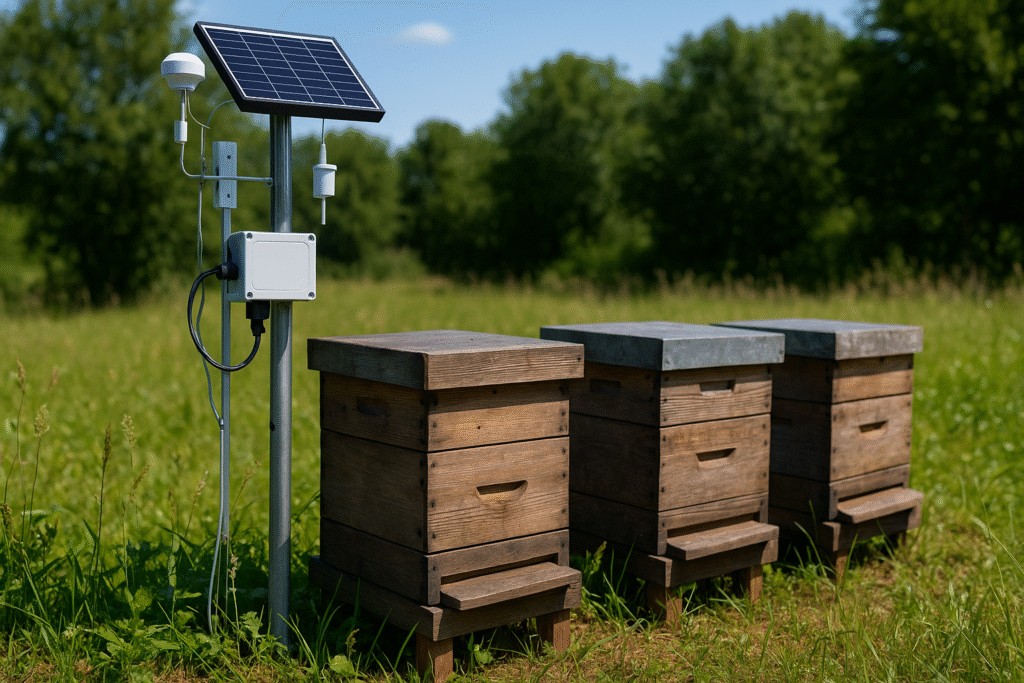
The ApitechWorld Outlook
Every year the apitech sector declares that the future is arriving any moment now. Smarter hives, cleverer dashboards, algorithms that promise to read the mind of the colony. Yet most of the real progress doesn’t happen in marketing decks — it happens quietly, in the everyday pressures of beekeeping: time, distance, weather, and the stubborn biology of bees.
2026 will be the year when the industry finally aligns with reality. Less hype. More practicality. Tools shaped by what beekeepers actually do rather than what engineers wish they would.

Here are the six forces that will define the year ahead.
1. The best smart hives will be the ones that help beekeepers do nothing
In 2026, the most valuable feature will not be an alert — it will be silence.
The sector is moving away from constant notifications toward tools that increase confidence in inaction. Beekeepers managing multiple or remote apiaries want to know when everything is normal more than when something is unusual.
A good system won’t make you twitchy.
A good system will let you stay home.
Expect new interfaces that emphasise stability, not alarms, and systems that grade the absence of change as a positive signal.
2. Connectivity will finally disappear into the background
By the end of of the decade, few beekeepers will care how their data gets to the cloud. The first impacts of this are going to happen in 2026. Whether iCellular, LoRaWAN, satellite, hybrid, intermittent uploads — it will all blur into one simple expectation:
“I don’t want to think about connectivity.”
This isn’t a technological leap, but a user-experience one.
Platforms that force beekeepers to understand signal bars, APNs, SIM plans, gateways, or antenna placement will quietly lose ground. Systems that simply work, even with sporadic contact, will set the standard.
The winners will treat connectivity like plumbing: essential, invisible, and never a topic of conversation.
3. Interpretation — not measurement — will become the battleground
Hardware has largely stabilised. Sensors are accurate, reliable, and cheap. So where will the innovation go?
Straight into meaning.
2026 will be the year when platforms compete on:
- clarity, not dashboards
- context, not raw charts
- probabilities, not promises
Expect more systems that incorporate forage patterns, weather, seasonality, and the beekeeper’s own history. Expect fewer fake-precision swarm predictions. And expect a backlash against “AI for bees” that cannot explain its decisions.
Interpretation is where trust is won or lost — and trust is where the market is heading.
4. Winter monitoring will become simpler, not more complex
For years, companies have tried to innovate winter survival with new sensors: CO₂, vibration, micro-acoustics, airflow. Most have added noise, not clarity.
In 2026, the pendulum finally swings back.
Beekeepers increasingly understand that two signals do most of the heavy lifting:
- weight stability
- temperature stability
These tell you whether a colony is consuming stores, maintaining cluster integrity, or slipping toward collapse. Everything else tends to distract more than illuminate.
Expect 2026 winter tools to focus on reliability over novelty: fewer sensors, better modelling, clearer thresholds, and almost no grandiose claims.
5. Growth will come from semi-professional and conservation apiaries, not beginners
The industry has long tried to sell high-tech tools to new hobbyists. But the real demand in 2026 will come from a different group entirely:
- small commercial operators
- conservation projects
- remote out-apiaries
- research-driven bee groups
- migratory pollination operations
These users manage distance, scale, and risk — where even modest improvements matter. They care about optimisation, not toys. They need prioritisation, not dashboards.
Expect pricing models, hardware packages, and support to shift toward serious amateur and semi-professional beekeeping.
Beginners will benefit downstream — but they will not lead adoption.
6. Trust will become the defining currency of apitech
2026 will reward the companies that resist the temptation to overclaim.
Beekeepers now recognise the difference between:
- a tool that reveals a change
- a tool that claims to diagnose a colony
Trust will accrue to systems that admit uncertainty, show the limits of interpretation, and explain how a conclusion is reached. Transparency will matter more than features. Modesty will outperform bravado.
The companies that thrive will be the ones that treat beekeepers as partners rather than impressionable consumers.
What this means for the year ahead
2026 won’t be the year of technological fireworks. It will be the year the apitech industry finally aligns itself with the bees — and the beekeepers — rather than with Silicon Valley fantasies.
Progress will come from simplification, not complication.
From clarity, not cleverness.
From tools that help beekeepers work with confidence — including the confidence to leave the hive alone.
The future of apitech is quieter, calmer, more honest.
And because of that, it will be better.