
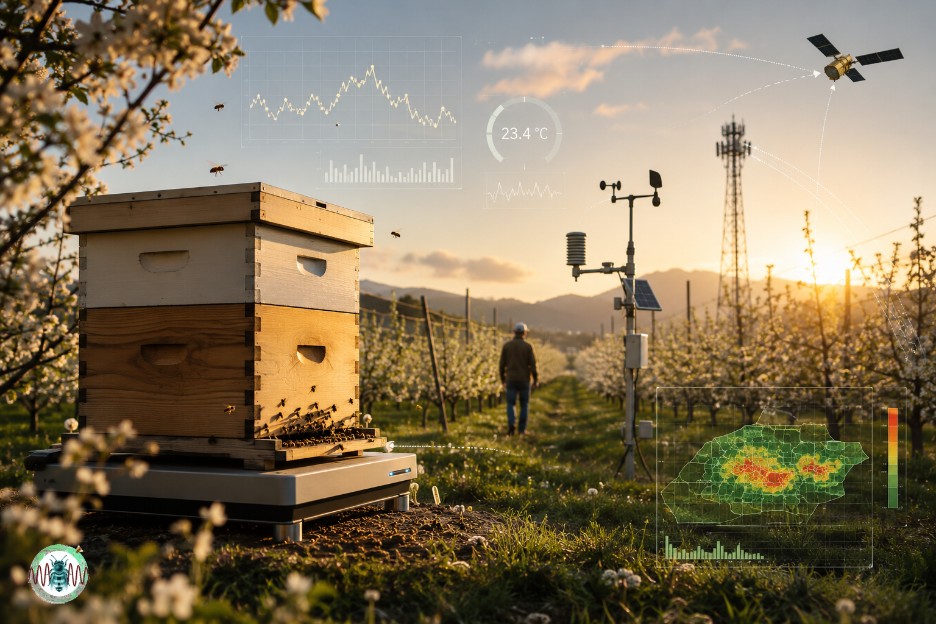
Technology, Bees and the Future of Pollination
If somebody had shown a beekeeper from 2010 the technology available today, they would probably have assumed two things.
First, that every hive in the world would now be connected to the internet.
Second, that colony losses would have become a thing of the past.
Neither prediction turned out to be true.
The modern apiary can contain hive scales that weigh colonies to the nearest gram, sensors that monitor temperature and humidity around the clock, acoustic systems that listen to the buzz of tens of thousands of workers, and artificial intelligence models searching for patterns hidden inside mountains of data. There are robotic hives, digital twins, computer vision systems and more dashboards than any sane person could reasonably wish for.
And yet, after all this innovation, a beekeeper can still find themselves standing in a muddy field on a cold spring morning wondering exactly the same thing their predecessors wondered a century ago:
“How are the bees doing?”
That isn’t a failure of technology.
“Every time the industry thinks it has found a silver bullet, the colony reminds everyone that it is dealing with a living superorganism rather than a machine.”
ApiTechWorld
If anything, it’s a reminder of the challenge. Bees remain gloriously resistant to simplistic solutions. Every time the industry thinks it has found a silver bullet, the colony reminds everyone that it is dealing with a living superorganism rather than a machine.
Which is why 2026 feels like such an interesting moment for apitech.
The excitement hasn’t disappeared, but some of the naivety has. The technology has improved. The expectations have become more realistic. A sector that spent much of the last decade fascinated by what it could measure is increasingly focused on what it can actually understand.
That may not sound particularly dramatic.
In fact, it may turn out to be the most important development of all.
From Curiosity to Industry
A decade ago, apitech was still something of an experiment.
There were enthusiastic startups, ambitious researchers and a small number of early adopters willing to bolt sensors onto hives and see what happened. Some projects succeeded brilliantly. Others vanished almost without trace. A surprising number produced graphs that looked impressive but left beekeepers none the wiser.
Looking back, there was something slightly endearing about those early years. Every new sensor seemed capable of revolutionising beekeeping. Weight sensors would transform colony management. Acoustic monitoring would decode bee behaviour. Artificial intelligence would predict swarming. Connectivity would bring every hive online.
The future was always just around the corner. Then reality arrived. Not hostile reality. Just normal reality.
The reality that batteries run flat. That mobile signals disappear in valleys. That weather influences almost everything. That colonies in neighbouring hives can behave completely differently despite experiencing the same conditions.
Most importantly, the industry discovered that collecting data and understanding bees are not quite the same thing.
This lesson has shaped much of what followed.
The good news is that the technology itself has improved enormously. The average hive monitoring system available today is more reliable, more affordable and easier to deploy than almost anything available five years ago. Sensors fail less often. Connectivity options have expanded. Software interfaces have become more usable. Many of the practical frustrations that plagued early adopters have quietly been solved.
The less comfortable truth is that biology remains every bit as complicated as it always was.
A hive scale can tell you a colony lost three kilograms in twenty-four hours. It cannot always tell you why. A temperature sensor can show changes in brood activity. It cannot explain every cause.
Even the most sophisticated AI model can struggle when confronted by the extraordinary variability of real colonies living in real environments.
The sector is gradually coming to terms with this.
Far from being a disappointment, that acceptance may be a sign of maturity. The technologies creating the greatest value in 2026 are rarely the ones making the boldest claims. Increasingly, success belongs to systems that help beekeepers prioritise, interpret and make better decisions rather than attempting to replace judgement altogether.
That shift in thinking can be seen almost everywhere.
Take hive monitoring, still the largest segment of the apitech market. A few years ago, many platforms promised unprecedented visibility into colony behaviour. Some implied that remote monitoring might one day eliminate the need for regular inspections.
Today the language is noticeably more modest. And considerably more useful.
Most experienced beekeepers now view monitoring systems not as replacements for inspections but as tools that help decide when an inspection is necessary. That distinction sounds subtle, but it changes everything. The goal is no longer to automate beekeeping. The goal is to focus attention where it matters most.
That is a far more achievable ambition.
And, as it happens, a far more valuable one.

The Search for Meaning
If hive monitoring represents the first phase of apitech, then interpretation represents the second. The industry spent years learning how to collect data. It is now learning how to make sense of it. This is where artificial intelligence enters the story, although perhaps not in the way many people expected.
A few years ago, the phrase “AI-powered” appeared on almost every technology product imaginable. Beekeeping was no exception. If a hive contained a sensor, there was a reasonable chance someone would claim artificial intelligence was involved somewhere along the way.
Some of those claims were little more than marketing. Others were genuinely interesting. The difference is becoming easier to spot.
The strongest applications of AI in beekeeping tend to be those that tackle problems humans find difficult simply because of scale. A beekeeper can compare a dozen colonies. A commercial operator might compare hundreds. A machine learning model can compare thousands and identify patterns that would otherwise remain hidden.
That creates genuine opportunities.
Disease detection is one example. Pollination forecasting is another. Behavioural analysis, yield prediction and colony health assessment are all areas where large datasets can reveal trends invisible to the naked eye.
The technology is becoming increasingly capable. The challenge, as ever, lies with the bees.
Unlike factory equipment, colonies do not behave consistently. Weather changes. Forage conditions fluctuate. Genetics vary. Local management practices influence outcomes. What appears to be a strong predictive signal in one region may prove far less useful elsewhere.
This is one reason why the most successful applications of AI in apitech rarely attempt to replace beekeepers. Instead, they function more like experienced assistants, highlighting unusual behaviour, identifying patterns and suggesting areas worthy of attention.
The distinction is important.
A beekeeper who believes software has eliminated uncertainty is likely to be disappointed. A beekeeper who uses software to reduce uncertainty may find it enormously valuable.
The industry is gradually learning this lesson.
Indeed, some of the most impressive technology companies in the sector are becoming less ambitious in their marketing and more ambitious in their execution. Rather than promising to solve beekeeping, they are focusing on solving specific problems. It is a subtle shift, but a significant one.
Nowhere is that more apparent than in the ongoing battle against Varroa.
If there is one subject capable of bringing together researchers, commercial operators, hobbyist beekeepers and technology startups, it is the small reddish-brown mite that continues to dominate conversations around colony health.
Varroa remains the defining challenge of modern beekeeping. It is also an excellent reminder that biological problems rarely yield to simple technological solutions.
The sector has responded with admirable creativity. Computer vision systems are being trained to identify mites automatically. Acoustic monitoring platforms are searching for behavioural signatures associated with infestation. Researchers are exploring machine learning techniques capable of detecting early warning signs before visible symptoms emerge.
Some of these approaches are genuinely promising. None of them has produced a silver bullet.
“The best connectivity solutions are becoming invisible. When they work properly, nobody talks about them.”
Eric Hewitson – Lacuna SPace
In truth, that may be asking too much. Varroa is not merely a technical challenge. It is an ecological, biological and management challenge rolled into one. Technology can help identify problems earlier, support treatment decisions and improve monitoring. Those are meaningful achievements. They simply do not remove the need for good beekeeping.
One suspects the mites are entirely comfortable with this arrangement. If Varroa represents the industry’s most persistent headache, robotics may be its most surprising success story.
Not so long ago, the idea of robotic beekeeping sounded faintly absurd. It belonged in the same category as flying cars and robot butlers: technically conceivable, perhaps, but unlikely to arrive anytime soon.
Yet here we are.
Companies such as BeeWise have demonstrated that automation can deliver genuine value in commercial pollination environments. Automated feeding, environmental management and colony monitoring are no longer experimental curiosities. They are functioning commercial systems solving practical operational problems.
That does not mean the future apiary will be populated entirely by robots. Nor does it suggest traditional hive designs are heading for extinction.
History rarely unfolds in such dramatic fashion.
More likely, automation will find its niche in large-scale operations where labour, consistency and logistics create powerful incentives for technological assistance. A commercial pollination contractor managing thousands of colonies faces challenges very different from those of a hobbyist with six hives at the bottom of the garden.
The interesting question is not whether robots will replace beekeepers. The interesting question is which tasks beekeepers are happy to hand over.
Every industry undergoing automation eventually arrives at this point. The technology becomes capable enough that the conversation shifts from possibility to practicality. Not “Can it be done?” but “Is it worth doing?”
Apitech appears to be entering that phase now.
And while much attention is focused on what is happening inside the hive, another equally important story is unfolding beyond it.
The further one travels into the apitech landscape, the more obvious it becomes that the hive itself is only part of the story.
After all, bees do not spend most of their lives inside hives. They spend them moving through landscapes. Fields, orchards, hedgerows, woodlands, meadows and gardens. Understanding the colony increasingly means understanding the environment in which that colony operates.
This realisation is quietly reshaping the industry.
For years, much of the technological focus was directed inward. More sensors. More measurements. More visibility into what was happening inside the box.
Today, some of the most interesting developments are looking outward. The first challenge is simply moving information around.
This sounds mundane, but it matters enormously. Bees have an inconvenient habit of living in places that network planners rarely prioritise. Remote orchards, isolated farms, conservation sites and mountain valleys are excellent locations for pollinators and less excellent locations for mobile phone coverage.
As a result, connectivity has become one of the unsung success stories of modern apitech.
Cellular networks remain important. LoRaWAN has found a growing role in agricultural environments. Satellite IoT, once considered an exotic niche technology, is becoming increasingly practical for remote monitoring applications. Hybrid approaches are emerging that blend multiple technologies together, allowing systems to prioritise reliability rather than theoretical performance.
Most beekeepers, understandably, do not care whether data arrives via cellular, LoRaWAN, Wi-Fi or a satellite travelling several hundred kilometres overhead.
They simply want it to arrive.
The best connectivity solutions are therefore becoming invisible. When they work properly, nobody talks about them. They quietly collect data, move it where it needs to go, and leave the beekeeper to focus on more interesting matters.
Like the bees. Or increasingly, the crops.
One of the most significant shifts within apitech over the past few years has been the growing importance of pollination intelligence.
Historically, commercial pollination relied heavily on experience, trust and reputation. Growers hired colonies. Beekeepers supplied them. Outcomes were assessed largely through observation and yield. That model is evolving.
Growers increasingly want evidence. How strong were the colonies? How active were the bees? What environmental conditions existed during flowering? Can pollination performance be measured rather than assumed?
These questions are creating entirely new markets for data.
Companies that once focused exclusively on hive monitoring now find themselves operating at the intersection of agriculture, analytics and ecosystem services. The hive is becoming not merely a biological asset but an information asset.
This may prove to be one of the most commercially important developments within the entire sector. For centuries, the value of bees has been understood primarily through their outputs: honey, wax and pollination. Technology is creating opportunities to measure and quantify pollination itself. The implications extend well beyond beekeeping.
They reach into food production, agricultural resilience and the broader challenge of feeding a growing global population while reducing environmental impact.
Which brings us to perhaps the most intriguing development of all. For a long time, apitech was largely concerned with helping people understand bees. Increasingly, bees may help us understand the world.
Researchers are exploring how connected hives can contribute to environmental monitoring programmes. Colonies interact with landscapes at remarkable scale, encountering flowers, pesticides, pollutants, weather events and changing habitat conditions across large geographic areas.
In effect, they function as thousands of tiny biological surveyors.
Viewed from this perspective, the hive becomes something more than a production unit. It becomes a sensor platform embedded within a living ecosystem.
The possibilities are surprisingly broad.
Biodiversity monitoring. Habitat assessment. Environmental health indicators. Climate adaptation studies. Pollinator conservation programmes. Landscape-scale ecological intelligence.
Some of these applications remain experimental. Others are already emerging into practical deployment. Taken together, they suggest that apitech’s future may ultimately be larger than beekeeping itself.
A decade ago, most conversations focused on how technology could help manage colonies more effectively.
Today, it is increasingly possible to imagine connected apiaries contributing data to agricultural systems, environmental monitoring networks and biodiversity programmes simultaneously.
The hive becomes part of a much larger story. And perhaps that is the defining theme of apitech in 2026.
The sector has spent years looking inward, trying to understand what happens within the colony. It is now beginning to look outward, exploring how colonies connect to the wider landscape and what they might teach us about it.
This feels like a significant moment. Not because it is flashy. Not because it involves particularly impressive hardware. But because it reflects a deeper maturity in the industry’s thinking.
The most exciting opportunities increasingly arise not from building yet another sensor, but from understanding how the information we already collect can be used more intelligently.
Which leads naturally to the question of where the sector goes next.
After spending another year wandering around the apitech world — reading the papers, watching the product launches, talking to founders, researchers and beekeepers — one conclusion feels increasingly difficult to avoid.
The future is unlikely to belong to the companies making the loudest claims. It will belong to the companies solving real problems.
The early years of apitech were characterised by experimentation. The current era is defined by refinement. The next phase will almost certainly be shaped by integration. Sensors, connectivity, analytics, robotics, pollination intelligence and environmental monitoring will increasingly converge into coherent systems rather than existing as separate technologies.
That may sound less exciting than a revolutionary breakthrough. In practice, it is usually how revolutions actually happen. Slowly at first. Then all at once. And through it all, one truth remains stubbornly unchanged. The smartest creature in the apiary is still the beekeeper. Not because technology has failed. Quite the opposite.
The best technologies are helping people become more informed, more efficient and more confident in their decisions. What they are not doing is replacing judgement. Nor should they.
Bees remain gloriously complicated. That is part of their charm. It is also why the future of apitech remains so fascinating. The industry’s task is not to outsmart the bees. It is to understand them a little better each year.
Judging by the progress being made across the sector, that feels like a future worth buzzing about.
Continue Exploring Apitech
Smart Hive Monitoring: A Beekeeper’s Reality Check
What modern hive monitoring systems actually do well.
What Sensors Are Used In Beehives?
A guide to weight, temperature, humidity and activity sensing.
Beekeeping Technology in 2025
What actually moved the needle over the past year.
Apitech in 2026
Six predictions shaping the future of beekeeping technology.