
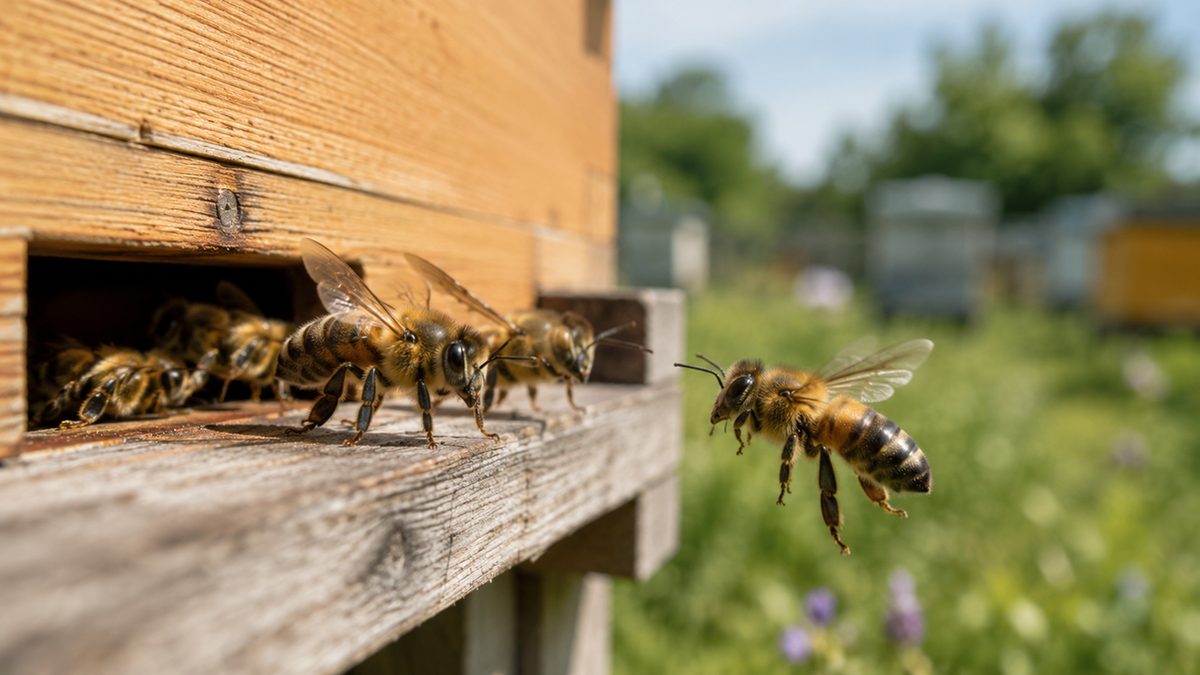
Bees are often presented as symbols of cooperation. The hive appears orderly, purposeful and almost impossibly coordinated. Yet anyone who has kept bees for more than a season knows the truth is more complicated. Bees are cooperative inside the colony, but the world outside the hive can be fiercely competitive.
There are bee borders. They are just not drawn on a map.
A honey bee colony does not patrol a fixed territory in the way a wolf pack might. Foragers from neighbouring hives can cross the same fields, visit the same hedgerows and work the same flowering trees. Their “territory” is fluid, shaped by distance, season, weather, flower availability and the strength of the colony. When forage is abundant, bees can appear remarkably tolerant of one another. When nectar dries up, the mood changes.
The first real border is the hive entrance.
This is where guard bees act as customs officers, bouncers and soldiers. Their job is to decide who belongs and who does not. They do this largely through scent. Each colony has its own chemical signature, built from genetics, wax, food sources and the shared odour of the nest. A returning worker is usually admitted. A wasp, robber bee or strange honey bee may be challenged, bitten, pushed away or stung.
But the system is not rigid. Bees make trade-offs. During a strong nectar flow, guards may become more permissive. A bee arriving loaded with nectar is often less of a threat than one arriving empty and desperate. During a nectar dearth, however, the colony tightens the border. Robbing becomes more likely, and guard bees become less forgiving.
This is where bee war begins.
Robbing is not casual theft. It is organised opportunism. Strong colonies may invade weak colonies to steal honey. The attack can escalate quickly. What begins as a few intruders testing a hive entrance can become a frenzy of bees fighting, tumbling and dying at the entrance. Once robbing gets going, the smell of exposed honey can attract more bees from more colonies, turning a single weak hive into a target.
For beekeepers, this is one reason careless handling can be dangerous. Leaving honey exposed, spilling syrup, opening weak colonies for too long or feeding in a way that spreads scent through the apiary can trigger conflict. A beekeeper may think they are simply inspecting a hive. The bees may read the situation as an opportunity for invasion.
There is also a quieter form of border confusion: drifting.
Bees do not always return to the correct hive. In crowded apiaries, especially where hives look similar and are arranged in straight lines, workers and drones may drift into neighbouring colonies. Drones are often tolerated more readily, but worker drift can move mites, viruses and pathogens around an apiary. This is not war exactly, but it is one of the ways colony boundaries become porous.
The wider landscape adds another layer of competition. Honey bees, bumblebees and solitary bees may all visit the same flowers. Sometimes they exploit different plants or forage at different times of day. Sometimes they overlap. A large managed apiary placed in a resource-poor landscape can increase pressure on wild pollinators, especially when floral resources are limited. Here again, the conflict is not dramatic hand-to-hand combat. It is competition by extraction.
The interesting lesson is that bee boundaries are behavioural, not geographical.
A colony’s border expands and contracts depending on risk. The entrance is defended more aggressively when food is scarce. Foraging ranges shift with the landscape. Strong colonies can become raiders. Weak colonies can become victims. Wild pollinators may be affected not because honey bees are malicious, but because thousands of extra mouths have been added to the same floral economy.
This matters for modern apiculture.
Good apiary management is partly about reducing unnecessary conflict. Space hives well. Avoid long identical rows where bees drift easily. Use visual markers to help orientation. Reduce entrances on weak colonies. Avoid exposing honey or syrup. Feed carefully. Think about forage availability before increasing colony numbers. And when moving bees into sensitive landscapes, consider the native pollinators already there.
The phrase “bee wars” sounds sensational, but it captures a real truth. The hive is not an isolated machine. It is a political unit in a crowded ecological world. Bees negotiate borders through scent, strength, hunger, memory and opportunity.
The peaceful hum of an apiary is not the absence of conflict. It is conflict being managed well.
AI Varroa Detection Tools and Products to Review
AI Varroa detection is still an emerging category, but it is no longer purely theoretical. A small number of apps and monitoring systems now claim to help beekeepers identify Varroa mites from phone images, inspection boards, frame photos or hive-entrance cameras.
These tools should not be treated as replacements for good beekeeping judgement, proper mite sampling or local treatment guidance. Their value is more practical: they may make monitoring easier, encourage more regular checks and create a better digital record of mite pressure over time.
| Product | Type | What it claims to do | Best review angle | Link |
|---|---|---|---|---|
| BeeScanning | Mobile app | Uses phone images of bees on brood frames to detect Varroa mites and brood issues using AI. | Probably the strongest starting point for a hands-on AI Varroa review because it is directly focused on mite detection from live bees on frames. | BeeScanning |
| HiveLog | Hive management app | Offers digital hive records, Varroa monitoring, treatment logs, queen records and AI-powered seasonal tips. | Best reviewed as a wider digital hive-record system rather than a pure image-based Varroa detector. | HiveLog |
| Beesly | Beekeeping inspection app | Includes hive inspection records, photo documentation, QR labels, weather features and AI mite counting from sticky-board photos in its Pro version. | Useful for reviewing whether AI mite counting works better when bundled into an everyday inspection app. | Beesly on the App Store |
| BeCure-ai Detecting | Mobile app | Claims AI-based Varroa detection from inspection-board photos, with trend tracking and hive-health statistics. | Worth including as a lighter app-store review, but it would need careful hands-on testing before drawing strong conclusions. | BeCure-ai Detecting on the App Store |
| Gratheon Entrance Observer | Hive entrance camera and AI monitoring system | Uses cameras and AI to monitor hive entrance activity, including bee traffic, pollen flow, robbing behaviour and Varroa mites riding on bees. | A more ambitious hardware review: less about a single mite-counting photo and more about continuous apiary surveillance. | Gratheon Entrance Observer |
| Beewise BeeHome | Robotic hive system | Uses robotics, computer vision and automation to monitor and manage colonies, including health threats such as Varroa. | Best treated as a commercial beekeeping automation review rather than a simple AI Varroa app review. | Beewise |